
Your Listening Area
 If you've been doing online research about setting up a home stereo system, you've likely run into a couple of dozen variations of the "keep the speakers 3 feet from the wall" and "set your listening chair mid-room" instructions. You will also have found considerable talk about room treatments and even soundproofing. This is all fine and good. Most of it will give you one banging good listening room.
But, unless you have an unused room you can turn over to a stereo system, the perfectionist instructions are not going to work for you. Setting up a stereo in a multi-use room, such as your living room or recreation room, is a whole different game.
If you are willing to break a few of the perfectionist rules it is not all that difficult. Once you understand a couple of basic things it becomes relatively easy to set up a surprisingly good system in your living room or recreation room. It's most often a matter of re-arranging furniture and organizing the system into the room. Later you can do some trial and error adjustments to fine tune the setup.
So, lets revisit the 1980s "stereo in the living room" and explore what you need to know in order to do a credible job of integrating a quality sound system into your existing rooms.
About speakers
When selecting your equipment the electronics will be a stable part of the system. Speakers, on the other hand, are mechanical devices that need to move air and they can vary over a wide range. You really can't just go out and buy the cheapest speakers, plunk them down in the room and expect success.Plan to spend about a third of your budget on speakers. If at all possible you should arrange to audition them before purchase, or at least make sure you have a return window so that you can try different speakers if you are not satisfied.
Because your system will most likely include a TV set the obvious place to put them is on either side. For this I suggest floor standing "tower" speakers rather than the bookshelf type. Towers generally have larger bass drivers and will fill a room more easily with balanced sound.
Most importantly, don't try to hide or disguise them. Speakers depend on free air at their front baffles to work properly.
The soundstage illusion
If you've been looking around the internet for help setting up a system or studying product reviews, you've undoubtedly run into a lot of talk about "soundstage". This phenomenon is falsely attributed to almost everything except the remote control in reviews and discussion of all kinds of audio gear. But what is it really and where does it come from?Soundstage refers to the way sounds appear to originate from different places. In a stereo system there are two obvious music sources; your left and right speakers. If you click the buttons below you can hear sound directly from each speaker.
Additionally, if you feed a sound equally into both speakers it will appear to come from a point in free space half way between your speakers. This is called the Phantom Center:
Mixing engineers can further refine this using Panning and other tricks on the mixing console that can locate a sound almost anywhere between the speakers. There are five general zones used for panning of signals:

Done correctly, this will create the audible illusion of a band playing in front of you. With good quality, well placed speakers you won't have any real awareness that you are listening to speakers, they seem to acoustically vanish.
The realism of this effect on properly mixed and mastered recordings is amazing the first time you hear it. Everyone ends up smiling. Then, it easily becomes an expectation every time after.
For movies, when the sound is down-mixed to stereo, the soundstage is used to make effects and music appear to come from the sides of the screen. In a properly setup system, the dialogue will appear to come from the person who is speaking on screen, not from your speakers.
You need to appreciate that the soundstage illusion is burned right into the recording you are listening to. It is not a feature of your electronics and is only moderately affected by your speakers. There are no rules about which sound goes where or which sounds are louder or quieter. The soundstage is -or should be- created for artistic effect, not according to some overused formula. Thus the soundstage can be totally different from one song to another, even on the same album.
The sweet spot
Now that we know the soundstage is a Psychoacoustic effect built right into our source recordings, the next step is to create a listening environment that takes full advantage of it.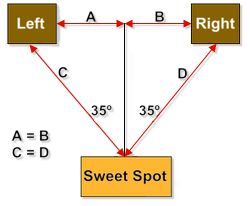
While listening on speakers, position yourself so you are centred in front of them. Now click the Phantom Centre button and slowly move your head side to side, closer to one of the speakers then the other. You should notice that for a distance the sound in the centre will follow you but then as you get close to a speaker it collapses into the speaker.
This range in the centre is called the Sweet Spot, where the full soundstage in the recording plays out in it's most realistic form.
The sweet spot is generally visualized as a triangle between the two stereo speakers and the listener. As shown at the right, it is important that distance A = B and C = D. The actual distance between the speakers or from the speakers to the listener are less important than maintaining this mirrored side to side relationship. Moving the speakers closer together reduces the width of the soundstage and moving them too far apart will weaken the centre of the soundstage. The best angle between listener and speakers along C and D is between 30 and 40 degrees but that can vary somewhat according to your room.
In general, so long as the geometry of the triangle places the listener equal distance from both speakers and centred between them the soundstage illusion will hold up quite nicely.
Planning your room
When doing this part, I generally like to make a 3D model of the room so I can see it from many different angles and try to find the best furniture and speaker placements before spending any money. To this end I use a free software package called Sweet Home 3D that makes this planning task a lot easier.Here are a few layout suggestions you should follow:
- You want to maintain the sweet spot as best you can.
- Don't have either the speakers or the listening position in a corner.
- Try to keep the system centred along the room, if possible.
- Be aware that you may need to move things a bit for fine tuning.
- Remember to keep the room convenient and accessible
But, beyond these simple guidelines, it's pretty much a matter for some creative room arranging and common sense.

The first thing to do, once you establish a floor plan for your listening area is to mark out boundaries to show were things can and cannot be moved. That is, you need to map out how far you can adjust the positions of your speakers and other bits of furniture without destroying the utility of the room.
At the right is a rendering of one of my models. This is an apartment living room, using stereo sound. With the couch opposite the speakers it does everything we need in terms of soundstage and the sweet spot. In this case we were also connecting to a television set so it made sense to position the television between the speakers and house the electronics underneath it. Even though designed around the home audio system, the room itself is still a comfortable place for family and guests.
Of course this is just an example. Your room will be different, they all are. The goal is to re-arrange or re-decorate around the audio/visual electronics, with the soundstage and sweet spot in mind and still create a nice room for your family.
Room acoustics
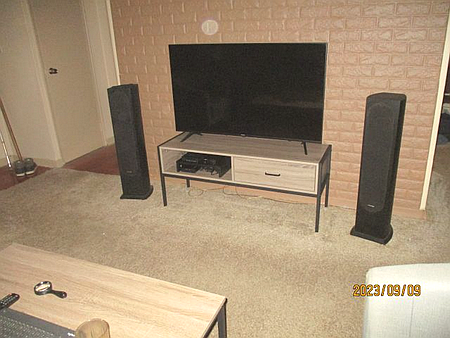 If you've been looking around the internet, you've no doubt come across the many room setup drawings with the listening position and speakers moved way out into the room and huge panels of acoustic treatments everywhere. It should be pretty obvious such idealized acoustics just aren't going to happen in a multi-use room. This, however, does not mean you will be stuck with either bad sound or an ugly room. It is most often possible to ignore the rules and get a perfectly good sounding setup after some trial and error adjustments.
Should you decide room treatments are necessary, there is no reason to make the room look like a recording studio. Most room problems come from hard smooth surfaces such as floors, windows, long walls, etc. Carpeting is a big help. Positioning a bookshelf or other furniture to break up a wall reflection can work wonders. Hanging heavy drapes over windows will help. Hanging Canvas Art can reduce echoes. There are even specialty Wallpapers you can put up to reduce reflections and echoes. The overall goal is to soften the room, which will relieve most problems.
Some final tweaks
Now that you have everything up and working there are a few small tweaks you can do to fine tune the sound.The biggest and cheapest tweak is to play with speaker positioning. Move them side to side, rotate them, move them closer or further from the front wall. But always be careful to maintain your sweet spot triangle. You will be surprised how small movements, less than a centimetre, can make a noticeable difference in the sound.
Move the furniture in similarly small increments. Reflections, diffusion and absorption of furniture can be helpful in putting that final oomph into your system.
Don't fuss with cables or fancy gadgets, they're not going to change the way your room reacts to your speakers. Always do the free stuff first.
Summing up
The audiophile's dedicated listening room has always impressed me as a somewhat unattractive and lonely place. Music should be for the whole family and that mandates a room where the family can gather, do their various activities and enjoy the music together.While this is by no means a complete guide to home audio setup, it should get you pointed in the right direction. Home audio systems are generally forgiving and should give reasonable performance in all but the worst cases. Once you understand the soundstage and sweet spot, it's really not that hard to plan a room for good music and movie sound.
If you want to experiment further you can download the Sound Samples in a zip file.